The Global & Domestic Economy
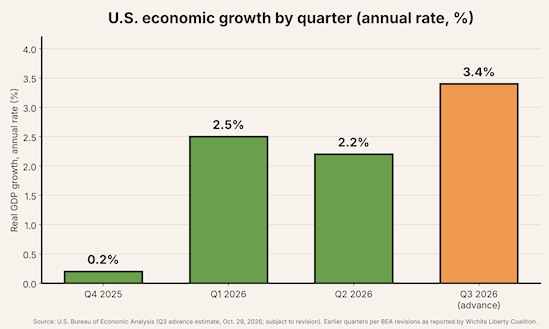
The U.S. economy grew at a 3.4% annual rate this summer, up from 2.2% in the spring. That beat forecasters' expectations of about 3.2%. Business investment, consumer spending and government spending drove the gain.
The catch is that prices haven't cooled. Inflation was 3.4% over the past year in August, so what cost $100 a year ago costs about $103.40 now. In September, the Federal Reserve raised its key interest rate a quarter point to 3.75–4.0%. It was the Fed's first hike since 2023. Higher rates generally make borrowing, like credit cards and loans, a bit more expensive.
The IMF expects the global economy to grow about 3% this year, down from 3.5%, after the Iran war closed the Strait of Hormuz, a route a fifth of the world's oil and gas passes through. Europe has been hit harder, while China is expected to grow near 5%.
The Global & Domestic Markets
The U.S. economy sped up this summer. Real GDP, the broadest measure of everything the country produces, grew at a 3.4% annual rate from July through September, up from 2.2% in the spring. That also beat what forecasters expected, which was about 3.2%. Business investment, consumer spending and government spending drove the gain. It's an early estimate that can still change, and the BEA says it is subject to revision.
The tougher part for households is that August inflation was 3.4% over the past year. Oil shocks from the Iran conflict kept that worry alive, even though the job market held steady, with 162,000 jobs added in August and unemployment at 4.1%. The Federal Reserve responded in September and raised its key interest rate by a quarter point to 3.75–4.0%, and J.P. Morgan expects one more small increase in December but not a long series of hikes. It was the Fed's first hike since 2023.
Around the world, the big story was energy. The IMF expects the global economy to grow about 3% this year, down from 3.5%, with prices worldwide up about 4.7%, after Iran shut down the Strait of Hormuz, a route a fifth of the world's oil and gas passes through.
Thoughts
Cook Financial's investment philosophy is to balance three different high level strategies, with lower allocations within those based on current market conditions. Our default is long-term views, with the goal of achieving the client's desired rate of return with low comparable risk. All though we do have long-term outlooks a short-term analysis is always enjoyable and informative.
an Equity component for growth and to combat inflationary pressures
an Indexed component to combat risk concerns and produce a minor level of income and/or growth
a Fixed component to combat volatility and unpredictability
Recent economic, market, and forecast data continues to lead us to be “cautiously optimistic” in the Equity component. While we continue to utilize low-cost passive holdings for efficient parts of the market, active management remains crucial to navigate the currently stretched valuations in the AI and tech space. The slight cooling of the market in Q3, specifically the tech based sectors, is a slight concern that we are keeping an eye on. We can see adjustments within the portfolio in Q4 to reduce overall exposure and tilt from the tech sector. The recent tech boom has been primarily driven by AI development but concerns of overall costs, who is going to large scale adopt, circular financing, lack of sustainable infrastructure from it, concentration of players, major inflation concerns, and continued conflicts in Iran has us thinking of portfolio tilt more towards value consumer staples, utilities (to benefit from AI use if adoption predictions happen), financials, & healthcare. Q3 only saw minor portfolio percentage adjustments as volatility rose a bit.
The Index component we increased allocation for portfolio management ease and added a weighting to it dependent upon outlooks that help to determine overall allocation. These strategies continue to serve their purpose effectively, providing a reliable structural barrier against market rapid price swings. This component is exceptionally helpful because it produces income that generally is insulated from immediate, headline-driven market movements.
The Fixed component has increased in attractiveness with the Fed rate increase and seeing rates in the mid-to-high 5% range. However, with the Federal Reserve potential future increases because of inflationary concerns has us slowly expanding further allocation.
Sources: U.S. Bureau of Economic Analysis (bea.gov); J.P. Morgan Wealth Management and J.P. Morgan Global Research; Charles Schwab; IMF via AP/PBS NewsHour; Vanguard; Dun & Bradstreet; LPL Research (Weekly Market Performance, Oct. 2, 2026); Morningstar; The Motley Fool/FactSet; Novel Investor (international returns); Wichita Liberty Coalition (quarterly GDP history). This is general information, not investment advice.